Hosted by TruLight Ministries International – The Place of Truth
SELECT YOUR READING LANGUAGE – BOTTOM LEFT = YOUR DAILY MANNA NOW AVAILABLE IN 103 LANGUAGES
@ TruLight Daily Manna is not Just a Bible Verse with a Small Prayer . NO ::: WE SERVE DAILY Manna for the ENTIRE Day . Breakfast , Lunch , Dinner , Plus tea Times and even Entertainment Manna . Plus News Manna and More , This Daily Manna will keep you Spiritually full for the full 48 Hours and even More to Share with your Friends and Family !!!
Fix Your House before you want to Fix the World

Don’t Police the World while Ignoring what is Happing in your Own Home or Church !
It is easy to point out the flaws in society, politics, and the culture around us. With social media and constant news cycles, anyone can become a full-time commentator on what is broken in the world. Yet, Scripture consistently warns against policing the outside world while neglecting the spiritual health of our own hearts, homes, and local churches.
Before trying to reform the world, God calls believers to start at home.
- Remove the Plank in Your Own Eye First
Jesus directly addressed the human tendency to focus on the sins of others while ignoring our own. In Matthew 7:3–5, He asks:
“Why do you look at the speck of sawdust in your brother’s eye and pay no attention to the plank in your own eye? … You hypocrite, first take the plank out of your own eye, and then you will see clearly to remove the speck from your brother’s eye.”
Self-examination is not about ignoring sin in the world; it is about gaining the spiritual clarity and humility needed to help others. When we refuse to confront our own pride, anger, or compromise, our attempts to correct the world become hypocritical and ineffective.
- Your Home Is Your First Ministry
In the Bible, a person’s home is the primary testing ground for their faith and leadership. When the Apostle Paul outlined the qualifications for church leaders, he tied their public authority directly to their private lives:
“If anyone does not know how to manage his own family, how can he take care of God’s church?” — 1 Timothy 3:5
It is a dangerous contradiction to fight culture wars online while your marriage is neglected, your children are starved for love and guidance, or bitterness rules your household. Your home is your first church. Building a house on Christ’s truth through patience, forgiveness, and integrity carries far more weight than winning an argument with a stranger.
- Judgment Begins with the House of God
The same principle applies to the church. Many believers spend endless energy criticizing the moral decay of unbelievers while turning a blind eye to division, gossip, unforgiveness, or false teaching inside the congregation.
In 1 Peter 4:17, Scripture reminds us:
“For it is time for judgment to begin with God’s household; and if it begins with us, what will the outcome be for those who do not obey the gospel of God?”
Similarly, Paul instructed the Corinthian church not to expect the outside world to act like Christians, but to focus on maintaining holiness, love, and accountability within the body of Christ (1 Corinthians 5:12–13). A compromised, divided church has no moral credibility when speaking to a broken world.
- Repair the Wall in Front of Your House
In the book of Nehemiah, the exiled Israelites returned to rebuild the ruined walls of Jerusalem. Rather than wandering around critiquing how others were building, each family was assigned to repair the section of the wall directly in front of their own house (Nehemiah 3).
Real transformation happens when believers take responsibility for the ground God has entrusted to them:
- Guard your own walk: Keep your private life aligned with your public confession (1 Timothy 4:16).
- Invest in your family: Lead your household with grace, prayer, and humility (Micah 6:8).
- Strengthen your local church: Pursue unity, truth, and genuine love among fellow believers.
The world does not need more self-appointed critics shouting from the sidelines. It needs Christians whose lives, homes, and churches reflect the transforming power of Jesus Christ. When we put our own house in order first, our lives become a living testimony that points the world toward true hope.

Tea Time Manna
Just as you received Christ Jesus as Lord, continue to live in him, rooted and built up in him, strengthened in the faith as you were taught, and overflowing with thankfulness.
—Colossians 2:6-7
Some things you don’t change, swap, or need to update. In an age when computer processors make major leaps every few months and software companies release upgrades every few weeks, we are programmed to look for the new and improved version of everything. The simple but profound truth, however, is that Jesus is Lord — no update needed. No rival is his equal. No change in him is necessary. In fact, if we stray from him as the basis of our lives, we put all we hold dear at risk. We are vulnerable to the world’s ubiquitous unraveling into decay and death. If we root ourselves in Jesus and his truth, if we make him the undergirding reality of our lives, and if we continue to grow into him, then our future is secured and our victory assured! Let’s rejoice that we have a love and love-giver who is Lord and who never needs updating or upgrading!
Prayer
Holy God, thank you for the simple, challenging, and enduring truth of Jesus’ love and lordship. I pray that you, Holy Spirit, will conform my life to more closely reflect Jesus’ character, love, and faithfulness (2 Corinthians 3:18) in my work, my family, and my daily influence as I love Jesus and live with him as Lord. In the name of that Lord, Jesus Christ, I pray. Amen and Amen
Truth Article by Pastor Dirk

“Follow Me, You Will Always Have the Poor”: What Jesus Really Meant
When people hear the phrase, “The poor you will always have with you,” it is often misunderstood as a reason to accept poverty as permanent or to give up on helping those in need. However, when read in its full biblical context alongside Jesus’s command to “Follow Me,” this statement reveals a profound call to active generosity, justice, and discipleship.
Two Distinct Commands, One Unified Mission
In the Gospels, the phrases “Follow Me” and “The poor you will always have with you” appear in different moments, yet they are deeply connected in Jesus’s teaching on what it means to live out one’s faith.
- The Call to “Follow Me” (Mark 10:21): When a wealthy man asked Jesus what he needed to do to inherit eternal life, Jesus told him to sell his possessions, give to the poor, and “come, follow me.” Here, following Jesus requires letting go of attachment to wealth and prioritizing the needs of others.
- The Anointing at Bethany (Matthew 26:6–13; Mark 14:3–9; John 12:1–8): Days before His crucifixion, a woman poured expensive perfume over Jesus. When some onlookers—specifically Judas—complained that the perfume could have been sold to help the poor, Jesus defended her, saying, “The poor you will always have with you, and you can help them any time you want. But you will not always have me” (Mark 14:7).
The Hidden Quote: Deuteronomy 15
To understand Jesus’s words at Bethany, we have to look at what His Jewish audience would have immediately recognized. Jesus was directly quoting Deuteronomy 15:11, a foundational Old Testament law about caring for the vulnerable.
In Deuteronomy 15, God commands Israel to cancel debts every seven years and establish economic systems that prevent systemic poverty. The passage concludes with a clear directive:
“For the poor will never cease to be in the land; therefore I command you, saying, ‘You shall freely open your hand to your brother, to your needy and poor in your land.'” (Deuteronomy 15:11)
By quoting this well-known verse, Jesus was not saying, “Ignore the poor because they will always be there.” Instead, He was reminding His disciples of the very next words in Scripture: because poverty persists in a broken world, God’s people must continually open their hands in generosity.
Why Jesus Said It in That Moment
Jesus’s response at Bethany served two immediate purposes:
- Exposing Hypocrisy: John’s Gospel notes that Judas did not actually care about the poor; he was a thief who wanted the money for himself (John 12:6). Jesus saw through false piety that used the poor as an excuse to criticize an act of genuine devotion.
- Recognizing the Urgency of the Cross: Jesus was preparing for His imminent death and burial. Opportunities to serve the poor are ongoing—Mark’s Gospel explicitly adds, “and you can help them any time you want”—whereas the window to honor Jesus physically before His crucifixion was closing.
What It Means to “Follow Me” Today
Far from encouraging apathy, Jesus’s words bind discipleship directly to caring for the marginalized. Throughout His ministry, Jesus taught that serving the hungry, the stranger, and the impoverished is equivalent to serving Him directly (Matthew 25:40).
To follow Jesus means recognizing that while human brokenness ensures there will always be people in need, believers are never excused from stepping in. True discipleship holds both truths together: wholehearted devotion to Christ and openhanded, relentless compassion for the poor
NEWS MANNA

The AI Cyberthreat: The Real Danger May Be Six Months Away

The warning may sound like something out of a science-fiction movie: artificial intelligence systems that search for weaknesses in computer networks, figure out how to exploit them and keep working without a person guiding every move.
But this is no longer only a theoretical concern. Google says it has observed an AI framework automatically searching for software vulnerabilities, developing exploits and attempting to use them without a human directing each step. The system did not suddenly develop its own motives or choose its own enemies. People built and set it in motion. But once it was running, it could carry out important parts of the attack process by itself.
Google believes the next stage could arrive quickly: multiple AI agents working together, followed by more sophisticated attacks that require little human involvement. The six-month timeline is a projection, not a promised date. But the first warning signs are already here.
For most people, the concern is not that an AI will single them out. It is that the bank, hospital, school, utility or business they depend on could become a target—and that the people behind an attack may be able to move faster than ever before.
The Break-In Could Begin While You Sleep
A cyberattack usually requires several steps. An attacker has to find a target, look for weaknesses, test a way in and then decide what to do after gaining access. In the past, much of that work required time and technical skill. AI can help automate parts of the process.
Google describes a framework that continuously analyzed software, compared different versions to look for vulnerabilities, drafted possible exploits and automatically tested them. Think of it as a system that can search for a digital door left unlocked, study the lock and try to open it—without waiting for a person to approve every step.
That does not mean the machine is acting independently in every sense. People still create the tools, choose their goals and set operations in motion. But they may not need to supervise every search or test. A human attacker can only examine so many systems at once. Automated tools can keep working at machine speed, including when their operators are offline.
That speed matters because the organizations we trust may not have much time to respond. A security flaw that once took days or weeks to discover and exploit could be found much faster. And a tool that can search across many systems could create more pressure on the people responsible for fixing weaknesses.
How a Distant Attack Reaches Your Front Door
You may never hear about the software flaw or the AI tool involved. You may only notice the consequences.
Your bank could lock an account after suspicious activity. Your doctor’s office might lose access to appointment or patient systems. A school could be forced to suspend online services. A local government might struggle to process payments or provide routine services. A business could lose access to its systems—or find that customer information has been exposed.
The attack may not be aimed at you personally. Your information could simply be stored in a system that someone else wants to break into. Or a service you rely on could be disrupted because its organization is dealing with an intrusion.
That is why this matters beyond the technology industry. Families depend on connected systems every day: to get paid, fill prescriptions, manage insurance, communicate with schools and pay bills. When an organization is compromised, the effects can show up as lost time, delayed care, unexpected costs, stolen personal information or the frustrating task of proving that a fraudulent transaction wasn’t yours.
And cybercriminals do not always need to shut down a power grid or a hospital to cause damage. Stealing login information, taking customer data or interrupting a company’s operations can bring real consequences to ordinary people.
The Race Is About Time
Organizations need time to notice an attack, understand how it happened, close the opening and check whether information or systems were compromised. AI could compress the attacker’s side of that race.
Google has reported seeing AI tools used to speed up vulnerability research and automate exploitation. It has also described attackers using AI frameworks to carry out parts of intrusions more quickly. The worry is that defenders may be dealing with attacks that move faster, reach more targets and require fewer people to operate.
There are limits today. Google says some autonomous tools leave traces that can help defenders detect them. Faster attacks may also be noisier and less careful. That gives security teams a chance to spot suspicious behavior and respond.
But detection is not a guarantee. Organizations still have to be prepared, keep systems updated and act quickly when warnings appear. Smaller businesses, schools and local agencies may not have the staff or resources of a major technology company. An attack that is manageable for a large organization could become a serious disruption for a smaller one.
Six Months Is a Warning, Not a Countdown
Google’s projection that more sophisticated, highly autonomous attacks could emerge within six months should not be treated as a date circled on the calendar. Forecasts about fast-moving technology can be wrong. The exact pace is uncertain.
The direction of travel is what deserves attention. Google says it has already seen a framework automate vulnerability discovery and exploitation without a person directing each step. The next development could involve multiple AI agents coordinating different parts of an operation, allowing attackers to search, adapt and act with less direct supervision.
That does not mean every cyberattack will soon be run entirely by machines. It does mean that the effort required to launch complex attacks could fall, while the speed and scale of those attacks could rise.
The systems we depend on are increasingly connected, and our personal lives are woven into them. When a hospital, bank or local service is hit, the consequences do not stay on a computer screen. They can reach a patient waiting for care, a family trying to access its money or a small business trying to make payroll.
The real danger may be six months away—or it could even arrive sooner. But the shift toward attacks that can work at machine speed has already begun as we have seen over this last week. The question now is whether the organizations holding our data and providing essential services can keep up.
Revival Behind Bars: The Gospel Is Reaching People We Gave Up On
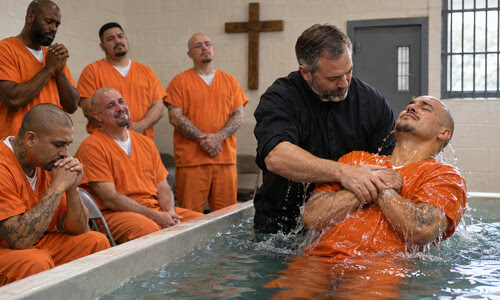
A prison is not where most people expect to find a revival. It is where people go after wreckage has piled up: broken families, addiction, violence, bad decisions and years that cannot be recovered.
Yet behind those walls, men are lifting their hands to Jesus. In one Oklahoma prison recently, 300 men gathered to seek God. The ministry reporting the event says 200 gave their lives to Christ and 47 were baptized. In Florida, inmates have been leading Bible studies and prayer meetings in their housing units. At one jail, 69 people were baptized in a single ceremony. One pastor described watching people who began with no hope gradually find purpose again.
The church should be asking why this is happening. But perhaps the harder question is why we are surprised.
The People We Give Up On Are Hearing the Gospel
The reports keep coming. In 2022, God Behind Bars said more than 450 inmates were baptized, compared with 90 the year before. In 2023, a federal women’s prison reported 130 baptisms. In 2024, women were baptized at another prison, while an outreach at Louisiana State Penitentiary saw hundreds of men and women make professions of faith. In 2025, an Oklahoma prison reported 400 decisions for Christ; 170 inmates were baptized at a Tennessee jail, and more than 100 men reportedly turned to Jesus in Mississippi.
These are not just numbers on a ministry flyer. Every number is a person who has been told, perhaps for years, that his worst choice is the truest thing about him. The Gospel says otherwise.
That does not erase the harm people have caused. It does not make victims’ pain disappear or turn justice into a meaningless word. But Christianity has never taught that a person must first become respectable before God can reach him. Jesus went looking for the lost. He ate with sinners. He told a dying criminal beside Him that hope was still possible.
Some people hear “jailhouse conversion” and assume it cannot be real. That skepticism may sound worldly-wise, but it can also reveal how little we believe grace can do. If a man turns to Christ in a church, we call it a testimony. If he does it in a cell, we call it a temporary reaction. Why? Because the setting is ugly? Because his past makes us uncomfortable? Or because we have quietly decided that some people are too far gone for the miracle we sing about on Sunday?
A Baptism Is a Beginning. Will the Church Show Up Afterward?
The most challenging part of these stories comes after the worship service.
In Walton County, Florida, churches have worked with the sheriff’s office to provide Bible study, prayer and worship. Inmates are encouraged to share what they learn with others in their housing units. Some people released from jail have joined the pastor’s church. Local ministries have also described connecting women with transportation, temporary housing, parenting classes and recovery programs.
That is what makes the difference between celebrating a dramatic moment and helping someone build a new life. A person can leave the water with a changed heart and still face the same temptations, debts, strained relationships and closed doors. If the church applauds the baptism but avoids the person afterward, we have mistaken the beginning for the finish.
One Florida pastor said the church had to accept people who did not have everything together—people who could be “a little bit of a train wreck.” That is not a special program for unusually compassionate Christians. That is the church being the church.
The need is plain. At a Walton County jail baptism, more than 70 inmates wanted to participate, but there were only enough authorized uniforms for 70. At another event, 69 people were baptized. The demand was greater than the space available. These men and women are not asking us to pretend their past never happened. They are asking whether a different future is possible.
The Revival Behind Bars Exposes the Poverty of Our Excuses
The prison walls make the contrast impossible to miss. People society has reduced to a mugshot are hearing that they are made in God’s image. People who may have been abandoned by everyone else are being told that Christ has not abandoned them. And churches are being asked whether they believe what they preach about forgiveness.
We can say “everyone deserves grace” and still make sure nobody with a record sits too close. We can praise redemption in a sermon and then refuse to offer a ride, a meal, a job lead or a place in the pew. We can sing about the lost sheep while deciding that this particular sheep is too dirty to bring home.
Jesus told of a father who ran toward his returning son. The father did not pretend the son’s choices were harmless. He welcomed him home because he was lost and had returned. That is the Father’s heart—and it should be the church’s heart too.
But grace does not erase consequences. A changed heart cannot undo a crime, return stolen years or automatically make victims whole. Those who have caused harm must face justice and make restitution where they can. Victims deserve protection, compassion and room to heal; no one should use forgiveness to pressure them into quick reconciliation or silence their pain.
The men and women behind bars need redemption. So do the rest of us. Their stories confront our pride, our suspicion and our habit of treating people as if their worst day is their permanent identity.
A cell can hold a body. It cannot place a boundary around the mercy of God. The question is whether we will believe that mercy when it reaches someone we would rather keep at a distance. If Christ can make a new life possible behind bars, the church has no excuse for keeping its doors—and its heart—locked.
PASTOR DIRK ASKS THE QUESTION ?
REVIVAL IN WHAT DOCTRINE ? Normally the Ruling Doctrine in the Jail Ministry are the Doctrine of Demons called . Oneness Gospel . Jesus only !! In what names are they Baptizing the Revivalists ?
Listen to our Radio Drama Play on this Topic !!

TruLight TV : Ways to Help Your Lonely Child Feel Connected
How can I help my child when they are lonely? In week two, we learn that everyone can feel lonely, just like the woman at the well (John 4 v 23–26). Meanwhile, at Konnect HQ, iWorship is back, and it’s louder than ever! Everyone at Konnect HQ thinks there’s nothing they can do to fix what’s gone wrong, but Captain Alissa arrives just in time to help. This and some stunning gospel kids’ songs. Enjoy!
Today on TruLight Radio XM
TruLight Radio XM 24/7
VISIT THE WEBSITE
https://trulightradioxm.org.za
TruLight Ministry News – EXTRA MANNA

TruLight Ministries orders from God since 2012 . Teach Them , Comfort Them and Warn Them!
a TruQuestion for the Day
What sign did God establish as the token of His covenant with Noah and all living creatures that He would never again destroy the earth by a flood?
Our TruPlay website – Stunning Music , Plays and Podcasts , Easy Radio Player and More https://truplay.co.za

TruLight News

A PLAY A DAY !


The Cost of Compromise: A Hard Truth from the Book of Genesis
We often look at the heroes of the Book of Genesis—figures like Abraham, Jacob, and Lot—through the lens of their greatest triumphs of faith. Yet, when you read their stories closely, Genesis refuses to sanitize their flaws. Instead, it presents an unflinching, hard truth: even people of genuine faith cause lasting generational damage when they trade God’s promises for fear-driven shortcuts.
The Pattern of Self-Preservation
Throughout Genesis, God repeatedly makes clear promises of protection and provision. Yet, when pressure mounts, the patriarchs frequently rely on deception and compromise rather than trust:
Abraham’s Deception (Genesis 12 & 20): Twice, out of fear for his own life, Abraham claims his wife Sarah is his sister, allowing her to be taken into the households of foreign rulers. To save himself, he places the very vessel of God’s promise in jeopardy.
Lot’s Compromise (Genesis 13 & 19): Lot chooses to pitch his tent near Sodom because the land looks prosperous, ignoring the spiritual danger. Over time, he moves inside the city gates, slowly losing his moral compass until his family is nearly destroyed when judgment falls.
Rebekah and Jacob’s Manipulation (Genesis 27): Rather than waiting for God to fulfill His word that the older son would serve the younger, Rebekah and Jacob orchestrate an elaborate lie to steal Isaac’s blessing.
The Ripple Effect of Shortcuts
The hard truth in Genesis is not merely that good people fail; it is that God’s grace does not erase the earthly consequences of our shortcuts.
While God remains faithful to His overarching covenant, the human fallout in Genesis is severe and deeply personal:
Broken Trust and Exile: Jacob secures the blessing through deceit, but it costs him his relationship with his brother Esau and forces him to flee his home for twenty years.
Repeated Generational Sin: Isaac repeats his father Abraham’s exact lie about his wife Rebekah (Genesis 26), and Jacob—the deceiver—is later deceived by his own sons regarding Joseph’s disappearance (Genesis 37).
Collateral Suffering: The innocent people around the patriarchs—such as Hagar, Ishmael, Leah, and Dinah—bear the heaviest emotional and physical burdens of decisions made out of impatience or cowardice.
Why This Truth Matters Today
Genesis strips away the illusion that following God exempts us from the laws of cause and effect, or that the end justifies the means. It confronts us with a sobering reality: trying to help God fulfill His promises through manipulation, fear, or compromise always creates deeper wounds than waiting in obedience ever could.
At the same time, this hard truth carries a quiet hope. Genesis proves that God’s purposes are not fragile. He works through deeply flawed, compromised people—not because their shortcuts succeed, but because His faithfulness is greater than their failures.
Artist Liners
Picture Manna to Share

From God –

From Jesus –

From the Holy Spirit –
TruLight Ministries International
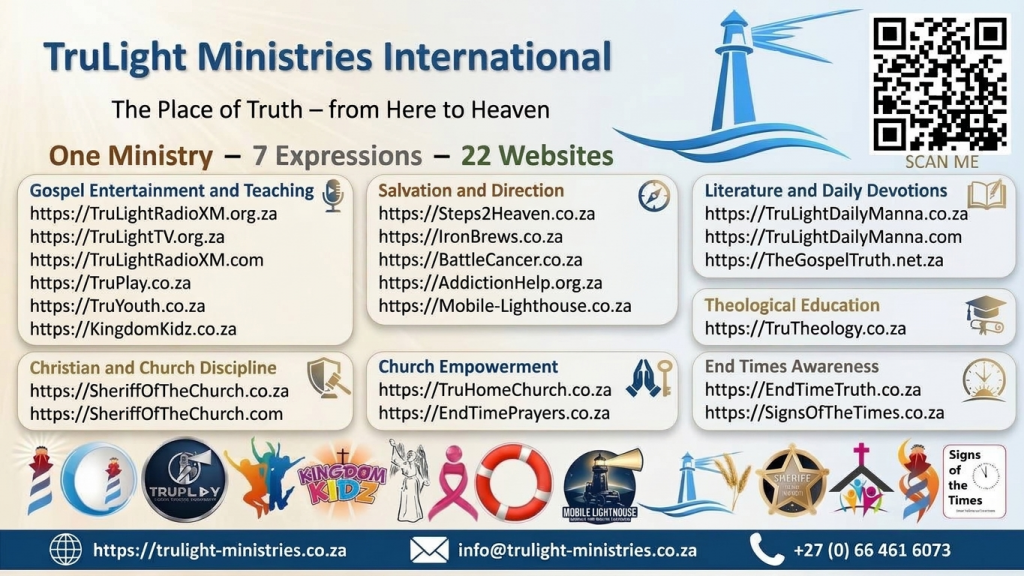
The Place of Truth – from Here to Heaven
One Ministry – 7 Expressions – 22 Websites
https://trulight-ministries.co.za
Gospel Entertainment and Teaching
https://trulightradioxm.org.za
https://trulighttv.org.za
https://trulightradioxm.com
https://truplay.co.za
https://truyouth.co.za
https://kingdomkidz.co.za
Literature and Daily Devotions
https://trulightdailymanna.co.za
https://trulightdailymanna.com
https://thegospeltruth.net.za
Church Empowerment
https://truhomechurch.co.za
https://endtimeprayers.co.za
Salvation and Direction
https://steps2heaven.co.za
https://ironbrews.co.za
https://battlecancer.co.za
https://addictionhelp.org.za
https://mobile-lighthouse.co.za
Christian and Church Discipline
https://sheriffofthechurch.com
https://sheriffofthechurch.com
End Times Awareness
https://endtimetruth.co.za
https://signsofthetimes.co.za
Theological Education
https://trutheology.co.za
Share this Feeding of Manna with your Friends and Family. just click on the Social Media icon and share !