Hosted by TruLight Ministries International – The Place of Truth
SELECT YOUR READING LANGUAGE – BOTTOM LEFT = YOUR DAILY MANNA NOW AVAILABLE IN 103 LANGUAGES
@ TruLight Daily Manna is not Just a Bible Verse with a Small Prayer . NO ::: WE SERVE DAILY Manna for the ENTIRE Day . Breakfast , Lunch , Dinner , Plus tea Times and even Entertainment Manna . Plus News Manna and More , This Daily Manna will keep you Spiritually full for the full 48 Hours and even More to Share with your Friends and Family !!!
The DANGER in the Church Nobody sees Coming !
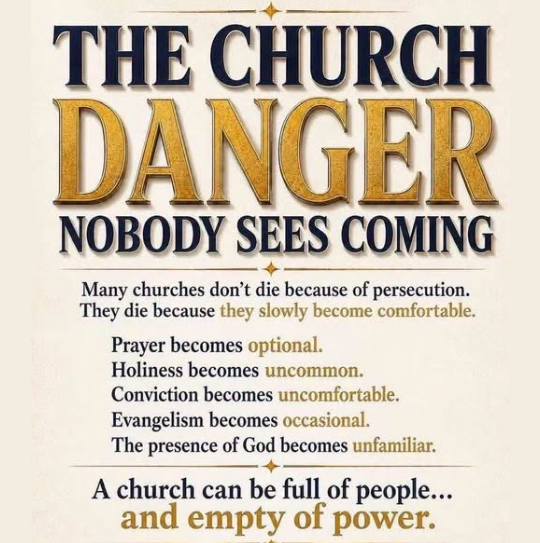
The Danger Already Inside the Church
Throughout church history, external persecution has rarely destroyed the Body of Christ; instead, it has often purified and multiplied it. The far greater, silent threat to a local congregation is internal spiritual complacency—a gradual drifting away from foundational biblical convictions while maintaining the outward appearance of religious activity.
Scripture warns repeatedly against a form of godliness that denies its power (2 Timothy 3:5), or a church that has a reputation for being alive while spiritually dead (Revelation 3:1). When comfort replaces urgency, decline happens slowly in five critical areas:
1. When Prayer Becomes Optional
In a vibrant church, prayer is the engine of every ministry, reflecting total dependence on God. When a church grows comfortable, prayer is often reduced to a brief transition between songs or an emergency measure during a crisis. Jesus reminded His disciples that “apart from Me you can do nothing” (John 15:5), and the early church devoted themselves continually to prayer (Acts 2:42). Neglecting prayer signals a quiet shift toward relying on human talent, strategy, and organization rather than divine intervention.
2. When Holiness Becomes Uncommon
Grace is meant to empower believers to live set-apart lives, not to excuse compromise. Over time, a comfortable church begins to mirror the surrounding culture rather than transforming it. Sin is minimized to avoid offending attendees, and the biblical call to “be holy, because I am holy” (1 Peter 1:16) is treated as outdated or legalistic. Without a pursuit of holiness, the church loses its distinct witness as salt and light in the world (Matthew 5:13–16).
3. When Conviction Becomes Uncomfortable
True biblical preaching is meant to comfort the afflicted and afflict the comfortable. Hebrews 4:12 describes the Word of God as living, active, and sharper than any double-edged sword, penetrating soul and spirit. However, when spiritual apathy sets in, congregations begin to prefer messages that affirm their lifestyle over sermons that call for repentance. As 2 Timothy 4:3 warns, people gather teachers to say what their “itching ears want to hear,” trading transformative truth for palatable encouragement.
4. When Evangelism Becomes Occasional
The Great Commission (Matthew 28:19–20) is the central mission of every believer, not a seasonal outreach event. Comfortable churches gradually turn inward, focusing almost exclusively on catering to the preferences of existing members rather than rescuing the lost. When a congregation loses its burden for souls outside its walls, it stops functioning as a lifeboat and becomes a cruise ship.
5. When the Presence of the Holy Spirit Becomes Unfamiliar
Perhaps the most tragic symptom of spiritual drift is when a church becomes so well-programmed that it no longer notices the absence of the Holy Spirit’s manifest power. In Revelation 3:15–20, Jesus rebuked the lukewarm church in Laodicea for feeling rich and self-sufficient while He stood outside knocking at the door. A church can have full pews, polished production, and thriving budgets—yet remain spiritually powerless without the active leadership and presence of the Holy Spirit (Zechariah 4:6).
6. The Falseness of a Escape Pod called Pre Tribulation Rapture are the Doctrine from the Pulpit
Building on the danger of spiritual complacency, many theologians and pastors argue that teaching a pre-tribulation rapture as an “escape pod” can unintentionally weaken the Church’s readiness for endurance and persecution. Rather than preparing believers to stand firm through dark times, an overemphasis on escaping hardship before trouble begins can foster passivity and spiritual unpreparedness.
How the “Escape Pod” View Affects the Church
- False Security Over Readiness: When believers assume they will be removed from the earth before any severe tribulation occurs, they often neglect the spiritual discipline required to endure suffering.
- Loss of Urgency: Treating the rapture as an automatic exit strategy can dull the urgency for holiness, deep prayer, and active evangelism today.
- Disconnect from Historic Christianity: For the first eighteen centuries of church history, Christians largely expected to face the Antichrist and tribulation before Christ’s visible return, relying on God’s grace to sustain them through trials rather than removing them from trials.
A Call to Spiritual Awakening
The remedy for spiritual comfort is not merely adding new programs, but returning to foundational repentance. Just as Jesus urged the church in Ephesus to “remember the height from which you have fallen, repent, and do the things you did at first” (Revelation 2:5), renewal begins when believers trade complacency for hunger—rekindling a devotion to fervent prayer, uncompromising holiness, bold evangelism, and surrender to the Holy Spirit.

Tea Time Manna
Whatever you do, whether in word or deed, do it all in the name of the Lord Jesus, giving thanks to God the Father through him.
—Colossians 3:17
Everything, all, no matter what! No matter what we say or do, we offer it as our gift of thanks to God, with Jesus’ name, power, and honor attached! This makes all of life our worship and thanksgiving to God. Every whatever, whenever, or whoever is offered to him in thanks and praise. There’s no such thing as going to church or going to worship. We offer all of our lives, all of ourselves, to God as our worship (Romans 12:1-2). We live, we talk, we interact with others, and serve as worship! And when we worship God, we always do it with thanksgiving and praise. So how has your worship been lately — at home, at work, in your recreation time, as you live? Let’s offer all of our lives to God in the name of the Lord Jesus!
Prayer
Almighty and Most Holy God, I want all of my life to be lived for your glory. May I be a living thanksgiving offered to you in appreciation for the grace you have given me in Jesus. While I do not always do this as well as I would like, I lovingly offer you my words, my actions, my heart, and my mind to bring you glory by doing your will and treating others as you would have me treat them. Please, use your Holy Spirit to remove the areas of self-deception from my life so that weakness, meanness, and hypocrisy will not rob my discipleship of its intended worship of your majesty. In the name of Jesus, my gracious Lord, I pray. Amen and Amen
Truth Article by Pastor Dirk

The “Escape Pod” Mentality and the Pre-Tribulation Rapture
Building on the danger of spiritual complacency, many theologians and pastors argue that teaching a pre-tribulation rapture as an “escape pod” can unintentionally weaken the Church’s readiness for endurance and persecution. Rather than preparing believers to stand firm through dark times, an overemphasis on escaping hardship before trouble begins can foster passivity and spiritual unpreparedness.
How the “Escape Pod” View Affects the Church
- False Security Over Readiness: When believers assume they will be removed from the earth before any severe tribulation occurs, they often neglect the spiritual discipline required to endure suffering.
- Loss of Urgency: Treating the rapture as an automatic exit strategy can dull the urgency for holiness, deep prayer, and active evangelism today.
- Disconnect from Historic Christianity: For the first eighteen centuries of church history, Christians largely expected to face the Antichrist and tribulation before Christ’s visible return, relying on God’s grace to sustain them through trials rather than removing them from trials.
Biblical Warnings Against Complacency in the Last Days
Scripture consistently calls believers to watchfulness, perseverance, and resilience rather than passive waiting:
- Endurance Through Tribulation: Jesus explicitly told His disciples, “In this world you will have trouble. But take heart! I have overcome the world” (John 16:33), and warned that “the one who stands firm to the end will be saved” (Matthew 24:13).
- Refined, Not Removed: In His high priestly prayer, Jesus prayed not that the Father would take believers out of the world, but that He would protect them from the evil one while they remain in it (John 17:15).
- Preparation for the Bride: Throughout the New Testament—such as the parable of the ten virgins (Matthew 25:1–13) and the armor of God (Ephesians 6:10–18)—the emphasis is on equipping believers to withstand the “evil day,” not bypassing it.
- The Timing of the Gathering: In 2 Thessalonians 2:1–4, Paul urges believers not to be unsettled by claims that the Day of the Lord has already come, clarifying that the rebellion and the revealing of the “man of lawlessness” happen before our gathering to Christ.
A Balanced Perspective on End-Times Teaching
While sincere Christians hold differing views on the exact timeline of the end times—including pre-tribulation, mid-tribulation, post-tribulation, and historic premillennial views—the consistent biblical mandate remains the same: live every day with the urgency of Christ’s imminent return while preparing your heart to endure faithfully through any trial.
NEWS MANNA

The Facial Recognition System Built To Find Terrorists Could One Day Find You

Imagine walking through a train station, a public square, or a checkpoint. A camera records your face. Software compares it with millions of stored images, finds a possible match, and pulls up a name and a file. You may never know it happened. You may never learn what the system thinks it knows about you.
That technology can help a country track down terrorists and search for hostages. After the October 7 attacks, Israel had urgent reasons to identify the people who carried them out. But facial recognition is spreading well beyond one battlefield and one purpose. The deeper question is what happens when the ability to identify people at scale becomes part of everyday life.
A recent report says the Israeli military uploaded 3.5 million Palestinian photographs to Amazon Web Services, or AWS, for analysis using Amazon Rekognition—Amazon’s facial-recognition and image-analysis service. The report describes a striking expansion in the scale of facial data available for searching. And that raises a question no country can avoid: Who will be able to use these systems tomorrow, and who will they be looking for?
A Face Becomes a Searchable Record
A photograph used to capture a moment. Someone had to recognize the person, identify them, and connect that face to other information. Facial recognition changes the equation. Software can compare an image with a large collection of stored photographs and produce possible matches in seconds.
Now imagine that capability connected to cameras in public spaces and databases containing names, family details, travel records, work permits, or past encounters with authorities. A face could become the key that ties those pieces together. Someone walking through a crowded area might be identified without speaking to an official or showing identification.
That does not mean every camera is watching every person all the time. Nor does a software match prove someone has committed a crime. But when facial-recognition software is connected to extensive databases and used at enough locations, it can make people’s movements and associations far easier to trace.
And the consequences of a mistake can be serious. A false match could lead to questioning, detention, or a lasting record that follows someone long after the system got it wrong. A person cannot simply change their face the way they can change a password.
The Purpose Can Change With the People in Power
The technology does not decide who is dangerous. People do.
Today, officials may say they are looking for terrorists, violent criminals, or missing hostages. Those are urgent and understandable goals. But a database built for one purpose can be kept, expanded, and searched for another. A new administration might define “extremist” differently. A security agency might decide that attending a protest deserves scrutiny. A government hostile to Christians might use similar tools to identify church leaders, track people attending a gathering, or map networks of believers.
The concern is that the capacity to identify and follow people does not belong to one government or one political moment. Once it exists, other governments can build similar systems—and future leaders can inherit systems created by their predecessors.
The progression could be gradual. First, cameras are installed to address a real danger. Then they are used for another serious crime. Later, authorities expand the watchlists or lower the threshold for an alert. Each step can be defended as a practical response to a new threat. Over time, the public may discover that being watched has become routine and that challenging a match is difficult.
“Now What?” Is the Question We Cannot Ignore
The Israeli security threat is real, and the search for those responsible for October 7 is not morally equivalent to the hypothetical persecution of Christians by a future government. But the legitimacy of one mission cannot settle every question about a technology that may outlast it.
Who is allowed to enter someone into a database? What evidence is required before an alert can trigger action? How long are images and records retained? Can people learn that they were misidentified and correct the record? Who checks whether the system is being used for the purpose officials originally promised?
Those questions matter because facial recognition can quietly shift the balance between the individual and the state. The government does not have to stop every person on the street. It may be enough to know who attended, where they went, whom they met, and which names to search later.
A camera can be installed in a day. A database can grow for years. And the officials who decide what the system is for today will not necessarily be the ones who control it tomorrow.
The danger is not that every face will immediately be tracked everywhere. It is that technology is making that kind of reach increasingly possible—and making it easier to tell the public that the people being watched have nothing to fear.
Until the day the target changes.
When Pastors Rewrite The Bible To Fit The Latest Ideology

The greatest evidence of God’s patience may be the steady stream of sermons that twist His Word to fit the spirit of the age.
A Lutheran pastor recently told her congregation that Joseph’s coat of many colors may have been a “pretty princess dress.” She then suggested that Joseph was a queer child who suffered violence because his brothers hated him for being queer.
That sermon is not an isolated case. Other pastors are recasting biblical figures through modern gender and sexuality categories, then presenting those interpretations as lessons the church needs to hear today. The details change. The method does not.
Joseph Gets a Makeover
Genesis says Jacob favored Joseph, his brothers hated him, and they eventually sold him into slavery. It says nothing about Joseph being queer.
The pastor builds her interpretation on speculation about the garment. She moves from the possibility that it resembled clothing worn by women to the claim that Joseph may have been a queer child targeted for who he was. From there, she asks what such a child could teach us about God.
That is a remarkable leap. A disputed detail becomes evidence for a modern identity; the identity becomes the key to understanding Joseph’s suffering; and the story is recast as a message about affirming people’s “true and whole” selves.
The text does not make that argument. The preacher does.
When Every Bible Story Becomes a Message
The same approach appears in sermons about the Ethiopian eunuch and Jacob.
At Myers Park Covenant Church, Rev. Dr. Tim Moore used the Ethiopian eunuch’s story in Acts 8 to connect the man’s ancient status to modern transgender and gay identities, then asked what that meant for LGBTQ inclusion. Acts says Philip explained the gospel and baptized the eunuch. It does not identify him as transgender or gay.
At Bethel Community, a guest preacher framed Jacob’s wrestling and new name in Genesis 32 through trans identity, asking how trans Christians might model “co-creating” identities with God. Genesis presents Jacob’s encounter as a struggle with God before he meets Esau. It does not describe a gender transition or teach that people create their own identities.
In each case, a preacher takes a biblical story, overlays it with contemporary identity politics, and draws a conclusion the passage itself never states. The Bible becomes a collection of characters to recruit for a cause.
The Pulpit Follows the Culture
Why is this happening? Because some churches have begun treating current cultural beliefs as the lens through which Scripture must be read. The preacher starts with the desired message, searches for a biblical character who can be made to fit, and then presents that connection as spiritual insight.
The result may sound compassionate and relevant. But it reverses the proper relationship between the church and Scripture. Christians are called to be corrected by God’s Word, not to reshape it until it approves of whatever the culture currently celebrates.
This matters because congregations trust their pastors to explain the Bible faithfully. When speculation is preached as biblical truth, listeners can leave believing the text says something it never says. Over time, Scripture’s authority gives way to the preacher’s assumptions.
A robe becomes proof of queerness. A eunuch becomes a transgender precedent. A new name becomes a lesson in self-creation. The church is no longer asking what God has said; it is asking how His Word can be made to endorse the message of the moment.
The pulpit is meant to proclaim Scripture, not rewrite it. When pastors turn biblical stories into mirrors for modern ideology, they are not helping the church understand God’s Word. They are teaching the church to replace it.

TruLight TV : Path To Personal Peace
Do you feel stuck in a situation? Watch this video and consider how God might be guiding you down a different way. Remember to look for Jesus in every trial because He is always there ready to counsel you. and later Wars, riots, domestic violence, and international conflicts—it’s clear that the world is not at peace. But our internal worlds don’t have to mirror this external chaos. In this message, Dr. Stanley speaks of Jesus Christ as the Prince of Peace and explains how we can find inner contentment and true rest through a personal relationship with Him. Don’t let things like anger, lust, or bitterness steal your peace. Learn how to trust God and let Him calm your soul with His soothing presence. Enjoy the music and message on today show.
Today on TruLight Radio XM
TruLight Radio XM 24/7
VISIT THE WEBSITE
https://trulightradioxm.org.za
TruLight Ministry News – EXTRA MANNA

TruLight Ministries orders from God since 2012 . Teach Them , Comfort Them and Warn Them!
a TruQuestion for the Day
In which city were Jesus’ followers first called “Christians”?
Our TruPlay website – Stunning Music , Plays and Podcasts , Easy Radio Player and More https://truplay.co.za

TruLight News

A PLAY A DAY !


The Hard Truth of Genesis: Why the Problem Isn’t “Out There”
We often approach the Book of Genesis looking for answers to cosmic questions: How did the universe begin? Where did humanity come from? Yet, if you read past the poetry of Creation in chapters 1 and 2, Genesis confronts us with an uncomfortable reality.
The hardest truth in Genesis is that the root of human brokenness does not lie in our environment, our circumstances, or even our enemies—it lies inside the human heart.
1. Paradise Was Not Enough
In Genesis 2, humanity is placed in Eden—a literal paradise. There is no poverty, no systemic oppression, no trauma, and no scarcity. Adam and Eve walk in unbroken fellowship with God.
Yet, in Genesis 3, they still choose rebellion. This shatters the modern assumption that if we simply fix a person’s environment, eliminate scarcity, or provide better education, human beings will naturally become good. Genesis insists that even in a perfect world, humanity chose autonomy over trust.
2. The Blame Game Begins Immediately
When confronted by God after eating the forbidden fruit, neither Adam nor Eve owns their failure.
- Adam blames Eve—and subtly blames God: “The woman whom you gave to be with me, she gave me fruit of the tree, and I ate” (Genesis 3:12).
- Eve blames the serpent: “The serpent deceived me, and I ate” (Genesis 3:13).
From the very first sin, shifting blame became our default defense mechanism. Accepting responsibility for our own spiritual and moral failures remains one of the hardest things for any person to do.
3. The Rapid Descent of the Human Heart
Genesis refuses to sugarcoat human nature. Immediately outside the garden, jealousy leads to the first murder as Cain kills his brother Abel (Genesis 4:8). By Genesis 6, the text delivers a sobering diagnosis: “The Lord saw that the wickedness of man was great in the earth, and that every intention of the thoughts of his heart was only evil continually” (Genesis 6:5).
Even after the Flood wipes the slate clean, the human condition remains unchanged. Just days after stepping off the ark, Noah falls into drunkenness and family shame (Genesis 9:20–27), proving that judgment alone cannot cure the human heart.
4. Even the “Heroes” Are Deeply Flawed
Unlike ancient myths that sanitize their founding heroes, Genesis exposes the worst moments of its patriarchs:
- Abraham lies twice about his wife Sarah to save his own skin (Genesis 12, 20).
- Jacob builds his early life on deceit, manipulating his blind father and cheating his brother (Genesis 27).
- Joseph’s brothers sell him into slavery out of pure envy (Genesis 37).
Genesis strips away the illusion that God chooses people because they are morally superior. There are no moral superheroes in Genesis—only broken people in need of grace.
Why This Hard Truth Matters
If our biggest problem is external, we can fix it ourselves through better policies, self-help, or willpower. But if Genesis is right—that our deepest fracture is internal—then we cannot rescue ourselves.
That is precisely why Genesis 3:15 introduces the first whisper of the gospel: a promise that one day, an offspring of the woman would crush the serpent’s head. Genesis forces us to confront the depth of our brokenness so that we will recognize our desperate need for a Savior.
Artist Liners
Picture Manna to Share

From God –

From Jesus –

From the Holy Spirit –

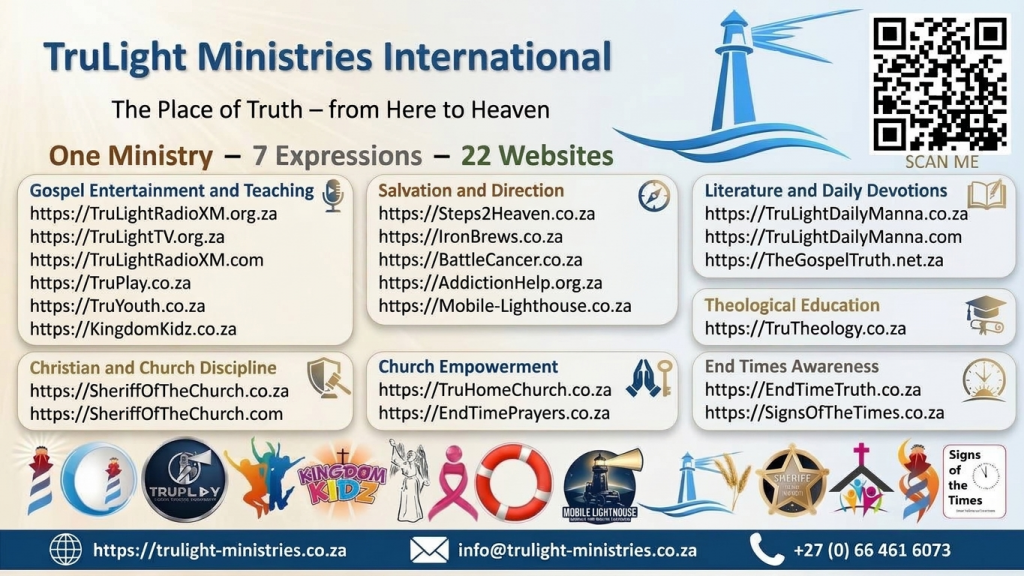
TruLight Ministries International
The Place of Truth – from Here to Heaven
One Ministry – 7 Expressions – 22 Websites
https://trulight-ministries.co.za
Gospel Entertainment and Teaching
https://trulightradioxm.org.za
https://trulighttv.org.za
https://trulightradioxm.com
https://truplay.co.za
https://truyouth.co.za
https://kingdomkidz.co.za
Literature and Daily Devotions
https://trulightdailymanna.co.za
https://trulightdailymanna.com
https://thegospeltruth.net.za
Church Empowerment
https://truhomechurch.co.za
https://endtimeprayers.co.za
Salvation and Direction
https://steps2heaven.co.za
https://ironbrews.co.za
https://battlecancer.co.za
https://addictionhelp.org.za
https://mobile-lighthouse.co.za
Christian and Church Discipline
https://sheriffofthechurch.com
https://sheriffofthechurch.com
End Times Awareness
https://endtimetruth.co.za
https://signsofthetimes.co.za
Theological Education
https://trutheology.co.za
Answer to Bible Question : Antioch (Acts 11:26)
Share this Feeding of Manna with your Friends and Family. just click on the Social Media icon and share !